About the workshop
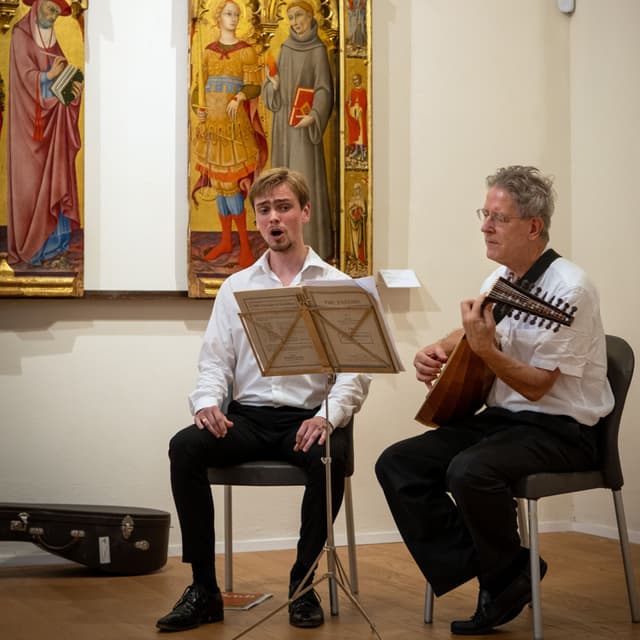
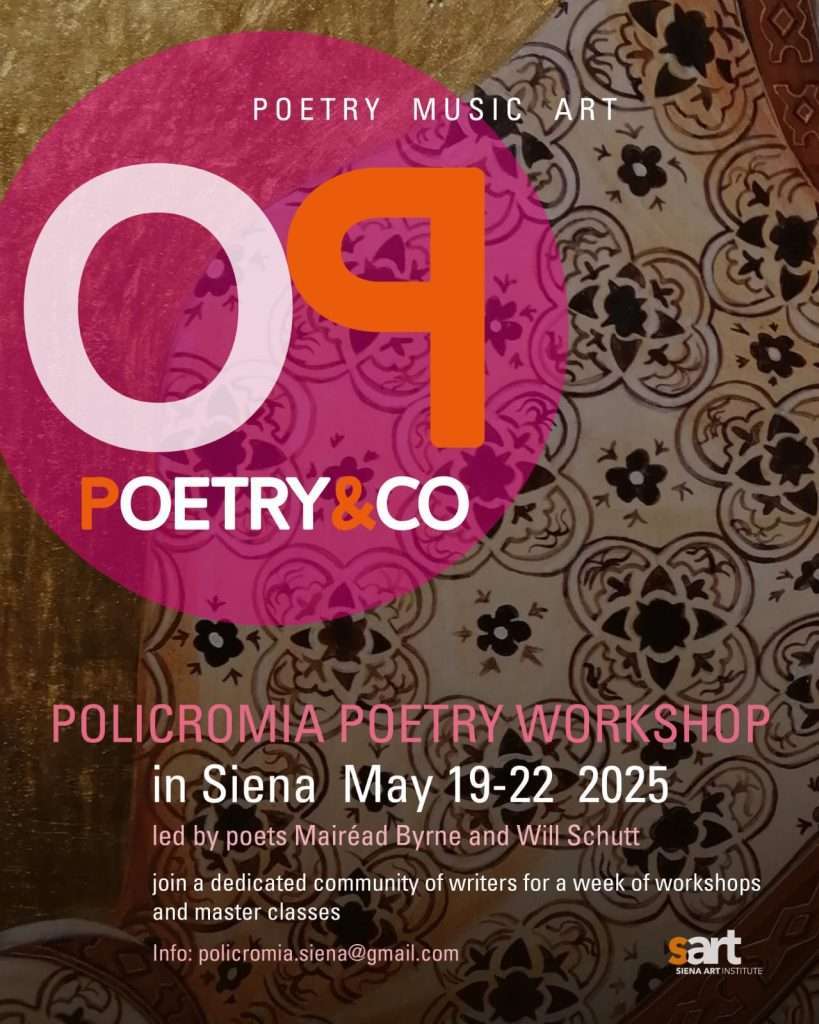
Workshops will meet daily Monday through Thursday (May 19-22) and will be supplemented with individual conferences, faculty-run Master Classes, and an introduction to the art and culture of Siena. Participants will workshop poetry, write new poems, confer with both faculty, and participate in a Wednesday evening reading, followed by a celebratory dinner. There will also be free writing time and opportunities to explore the city, with expert guidance. The Workshop dovetails with the Festival (May 22-25).
About the festival
Policromia is a local and international festival centered on poetry and translation. For three days, a group of acclaimed poets, translators and artists gather in Siena for readings and panel discussions, giving workshop participants further opportunities to immerse themselves in poetry, translation, and the city. In fact, our venues are woven into the texture and fabric of the city of Siena, from the most magnificent halls, museums, and galleries to artisan workshops, bars, and commercial spaces. We are happy to announce our 2025 guests: Caleb Femi, Carmen Gallo, Celia de Fréine, Franca Mancinelli, John Murillo, Laoighseach Ní Choistealbha, Luke Kennard, Nicole Sealey.
Master Classes
Poetry Today
In a 1990 interview with Neal A. Lester, poet, playwright, and genius Ntozake Shange said, “I’m a firm believer that language and how we use language determines how we act, and how we act then determines our lives and other people’s lives.” This affirmation by Shange is often quoted. Is it still true? What would you write if you were a Poet Laureate today? In this workshop, we will read and write poems which address daily life today, in any part of the world, keeping in mind the wide, unpredictable, imaginative reach of poetry and our multiple identities and responsibilities. Does the weight of those responsibilities distinguish us from AI? What is the grey area of witnessing? Is craft sacrificed when we respond directly to what we see or hear in the news? Do you want to write a poetry that is a through line to action? Or something else?
Poetry Today Into Other Words: Translation, Code-Switching, and Making English Strange
In this class we will explore the pains and pleasures of translating literary works and the rewards of translation to our own creative practices. We will examine a variety of “literal” and “free” translations, consider fidelity to the letter and the spirit of a foreign work, and try our own hand at translating short poems and prose passages. In the process, participants will gain a deeper appreciation of the art of translation and the hybrid nature of language itself. No foreign language or previous translation experience is required.
Line, Sentence, and the Magic of the Prose Poem
What does the prose poem lose or gain by refusing poetry’s prime instrument—the line? Is the sentence in the prose poem equivalent to the line in poetry? How can the pedestrian sentence possibly compete with the musical, mathematical, virtuosic, memorable line? Maybe there’s no competition. The line declares that poetry is there. But sometimes it isn’t. The sentence declares poetry is nowhere to be found. But sometimes it is. In this master class, we will look at what poets do with the line and sentence, and see where we can locate poetry in the prose poem particularly.
Poetry Abroad
Italy has been fertile ground for modern and contemporary American poets. James Wright’s This Journey and Henri Cole’s The Visible Man have sprung from its soil, to give just two examples. Creative engagement with a foreign country can also help us understand our relationship to our own traditions and homes. In this class we will discuss how American poetry has been shaped by the landscape, literature and art of Italy, and broaden the conversation to consider the role of place in poetry, the perils of othering, and how foreign exchange can be fruitfully employed in our own poems.
Application Guidelines
Applications are accepted until March 15, 2025. We accept applications on a rolling basis and will notify applicants of acceptance. Early applications are encouraged. Please submit a brief Statement of Interest (approximately 300 words) and a manuscript of your strongest work to policromia.workshop@gmail.com
Statements of Interest should appear in the body of your email. In your statement, please tell us:
– why you want to attend the Workshop
– your previous experience, if any, in writing workshops
– what you most want to gain from the Workshop (and Festival)
– whatever else you would like us to know Please write Your Name + Application Policromia Workshop 2025 in the subject line of your email.
Manuscript guidelines
– 10 pages total, with a cover page with a list of all poems included
– Your name and a page number should appear on each page of the manuscript.
– Manuscripts should have 12-pt. font and may be single- or double-spaced.
Payment instructions:
The €750 fee includes workshops and individual conferences with both instructors, attendance at master classes and all events of the festival program, wine receptions, two celebratory meals, Sunday brunch, and short guided tours.
Fees do not include transportation to and from the airport. However, we can organize transportation at an addition- al cost. Applicants wishing to avail of this must notify us two weeks before the start of the workshop.
Please contact office@sienaart.org for information about transportation connections to arrive to Siena.
– Non-refundable deposit of €300 due by March 31, 2025, by PayPal
– Remaining €450 due by PayPal April 30, 2025. Fully refundable before April 30, 50% refundable before May 9.
Contact Us
You are welcome to contact us at policromia.workshop@gmail.com
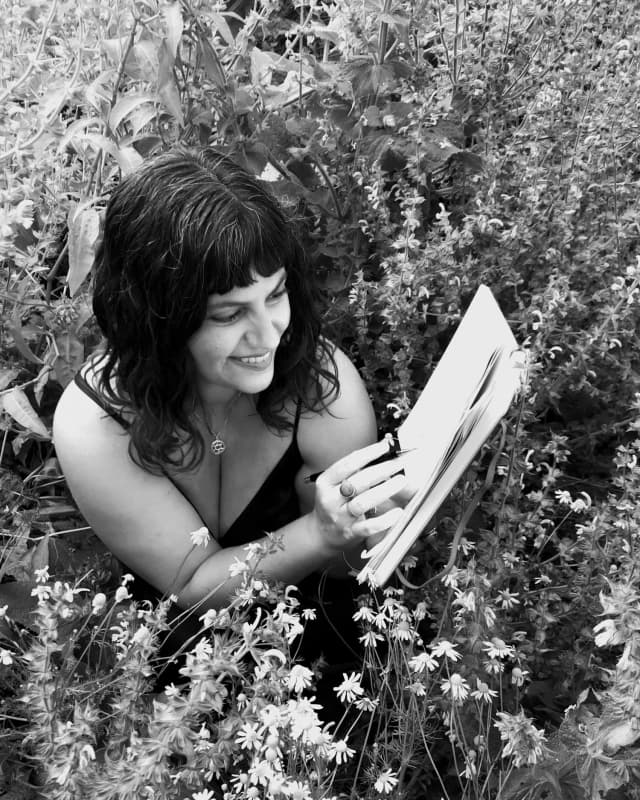
MAIRÉAD BYRNE is the author of six poetry collections, Nelson & The Huruburu Bird (Wild Honey 2003), Talk Poetry (Miami University Press 2007), SOS Poetry (/ubu Editions 2007), The Best of (What’s Left of) Heaven (Publishing Genius 2010/2019), You Have to Laugh: New & Selected Poems (Barrow Street 2013), and Famosa na sua cabeça (Dobra Editorial 2015); also nine chapbooks. Her poems have been published in anthologies including Staying Human / Staying Alive (Bloodaxe 2020); The Cast-Iron Airplane That Can Actually Fly: Contemporary Poets Comment on Their Prose Poems (2019); Women : Poetry : Migration (2017); Out of Everywhere 2: Linguistically Innovative Poetry by Women in North America & the UK (2015); If Ever You Go: A Map of Dublin in Poetry and Song (2014); The Best of Irish Poetry 2007; Krino 1986-1996: An Anthology of Modern Irish Writing (1996); Ireland’s Women: Writings Past and Present (1994); and The New Younger Irish Poets (1991); also a wide range of journals in the United States, Ireland, and the U.K. She is a Professor of Poetry and Poetics at Rhode Island School of Design in Providence, serving as Chief Critic for the RISD European Honors Program in Rome in 2013, and being honored with the Frazier Award for Excellence in Teaching in 2016. For seven years, she co-curated couscous, a diverse poetry/performance event in Providence (USA) and Cork (Ireland). Along with Will Schutt and Miriam Grottanelli, she is the co-curator of Policromia, an annual international festival of poetry and translation across the arts, in Siena, Italy.
WILL SCHUTT’s work has been recognized with numerous awards, including the Yale Younger Poets Prize, the Amy Lowell Travelling Poetry Fellowship, a National Endowment for the Arts Literature Translation Fellowship, and the 2019 Raiziss/de Palchi Translation Award from the Academy of American Poets. He is the author of Westerly (Yale University Press, 2013) and translator of several works of poetry, fiction and nonfiction, including Brief Homage to Pluto and Other Poems by Fabio Pusterla (Princeton University Press, 2023; winner of the Joseph Tusiani Prize), My Life, I Lapped It Up: Selected Poems of Edoardo Sanguineti (Oberlin College Press, 2018; winner of a PEN/Heim Translation Fund grant) and Fabio Genovesi’s novel The Breaking of a Wave (Europa Editions, 2017; shortlisted for the 2018 ALTA Italian Prose in Translation Award). His poems and translations have appeared in Agni, Copper Nickel, the Literary Review, the New Republic, the Sewanee Review, the Yale Review, and elsewhere. Over the last fifteen years he has taught writing workshops and master classes in poetry and translation at the Bread Loaf Writers’ Conference, Bucknell University, Goucher College, Hollins University, and the University of Maryland, College Park. He currently teaches creative writing at John Cabot University, in Rome. Along with Mairéad Byrne and Miriam Grottanelli, he is the co-curator of Policromia, an annual international festival of poetry and translation across the arts in Siena, Italy.